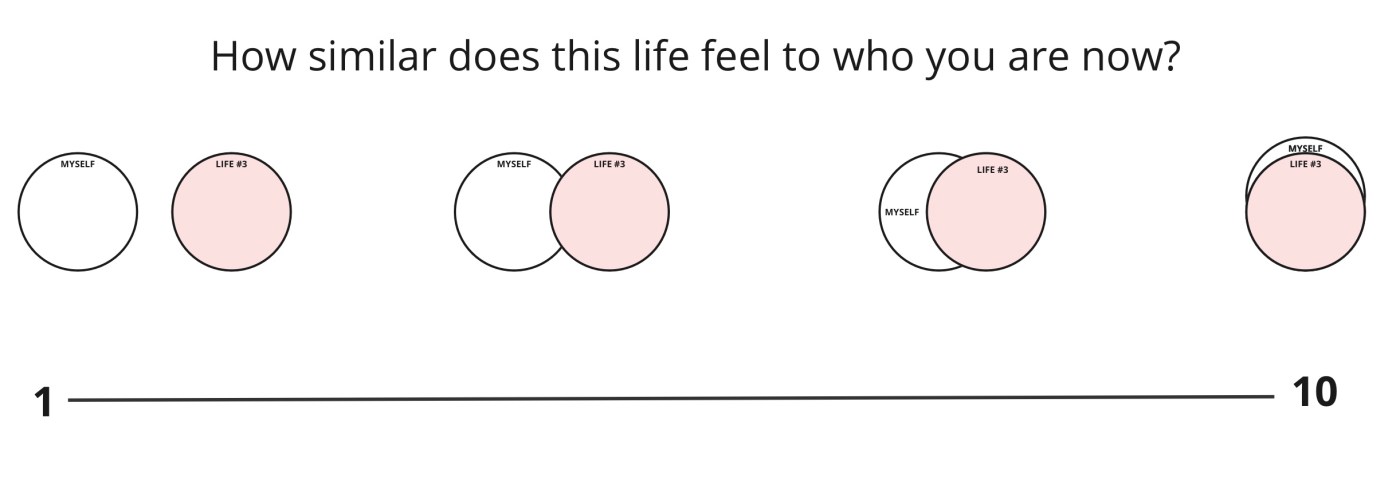
In his new book, Your Future Self: How to Make a Better Tomorrow, Today, Hal Hershfield illustrates the ways in which insights from the psychology of relationships can be applied to your future self. Building off of Art and Elaine Aron’s concept of “inclusion in the self,” Hershfield and his colleagues found across several studies that the more people viewed their imagined future selves to be similar to who they are now, the more likely they were to behave in ways (i.e. saving money, making ethical decisions, exercise more frequently, etc.) that benefit this future self. “In short,” Hershfield concludes, “the closer you feel to your future self, the better you’ll prepare for your future, whatever it may bring.”

Hershfield’s use of “connection” got me thinking about the ways in which we ask students to reflect upon and assess the lives that they imagine in an Odyssey Plan / Three Lives Activity. In Designing Your Life, Bill Burnett and Dave Evans have participants assess their Odyssey Plans according to four different criteria: Resources (do I have the means to do it?); I Like It (would I like to do it?); Confidence (can I do it?); and, Coherence (would doing this align with my values?). The future life that has the fullest gauges is the one you prototype first.

I’ve been critical of the Odyssey Planning activity (see HERE for example), especially when used for undergraduate students, so it shouldn’t come as a surprise that I am somewhat skeptical of the reflection component. Especially when we consider those “wild” possibilities that constitute our Life #3, it’s hard to assess whether we have the resources to pursue this path; or, whether this path aligns with the values not just of who we are now, but of who we might become; or, whether in the face of all this uncertainty, we have confidence in our success in pursuing this path. Those blessed with wealth and social capital (and the self-confidence that these often convey) might be inclined to rate an ambiguous future highly, but most of us would not be so confident and would likely shy away from this path, choosing instead to move forward with the more familiar Life #1.
Hershfield’s work offers a compelling alternative approach. By asking students to assess whether the future version of their future self that they imagined feels “similar” to how they are now, they can get a sense of whether they would be willing and able to take the actions in order to make this future a reality, even – and this is critical – when those actions are unclear. Next time I run my Three Lives activity, I’m thinking of including something like the following:
 Education * Designed
Leave a comment